Why a Doorway Is More Than an Opening
Why a doorway is more than an opening: see how thresholds guide movement, signal transitions and shape the feeling of arriving in a place.
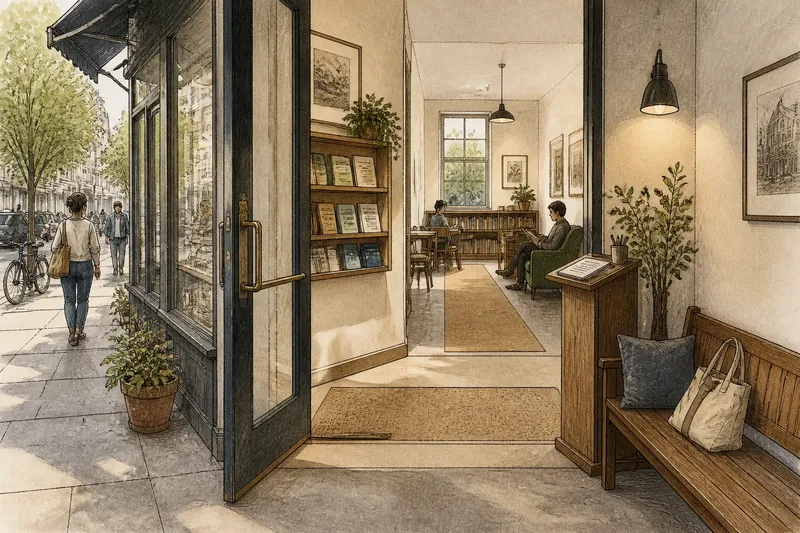
The common mistake with a doorway is to treat it as empty space between two rooms. That can make an entrance feel awkward: people hesitate, collide, or carry the bustle of one space straight into another. A doorway is more than an opening because its threshold helps organize movement and tells the body, quietly, that a change is taking place.
Imagine a hypothetical neighborhood reading room being fitted into a narrow storefront. Its entrance faces a busy sidewalk, and the room inside is meant to feel calm without seeming private or forbidding. The people shaping the space have a modest question: what should happen between the street and the first chair? Their choices offer a useful way to think about thresholds without pretending there is one ideal doorway for every place.
The Arrival Sequence
At first, the imagined room has a single clear view from sidewalk to reading table. The glass door opens inward, and a visitor stepping in meets a chair almost immediately. The route is short, but the transition is abrupt: street sounds and foot traffic seem to spill into the quiet area, while someone pausing to orient themselves blocks the entrance.
The designers do not need to make the room larger to change that experience. They can create a small arrival sequence: approach, opening, pause, then movement toward the reading area. A short clear patch just inside the door gives a visitor room to close it, look around, and decide where to go. It functions like a landing at the top of a staircase: not the destination, but a useful place to gather oneself before continuing.
This pause need not be a separate vestibule. A shift in floor material, a bench set to one side, or a view toward a welcome desk can mark the threshold. The choice depends on the storefront’s layout and the people using it. The point is to make the first movement legible rather than force every visitor to improvise in the doorway.
Routes Through the Room
A doorway organizes more than arrival. It suggests which paths are open, where people may wait, and whether entering means moving straight ahead or turning. In the hypothetical reading room, a narrow runner could lead from the entrance toward a welcome shelf, while chairs sit outside the direct walking line. That arrangement lets a newcomer pause without becoming an obstacle.
These signals are useful because people read a space with their bodies as well as their eyes. A visible route can feel inviting; a blocked or ambiguous one can make a visitor wait for someone else to move first. The reading room’s entrance should therefore account for more than its most direct path. Someone carrying a tote, using a cane, or entering with a child needs enough room to approach and turn without negotiating around furniture.
Say the fictional team places a sign-in stand directly opposite the door. A visitor who needs to stop there would interrupt anyone entering behind them. If the stand moves to a side wall, the doorway can continue to serve as a passage while the visitor completes the small task. The observable result would be a clearer separation between walking through and stopping to get oriented.
Signals at the Edge
Thresholds can mark a change through material, light, sound, or touch. A coir mat may signal “wipe your shoes”; a strip of tile may distinguish an entry from a carpeted room; a curtain can soften a view while still allowing passage. Such cues are not fixed symbols with the same meaning everywhere. Their effect depends on local habits, the building, and the people who use it.
In the imagined reading room, the team considers a heavy mat and a low change in floor level. The mat could help catch dirt, but a curled edge or abrupt lip might catch a foot or wheel. A flush surface with a contrasting texture may mark the entrance more gently. The design decision is not simply which material looks welcoming; it is whether the cue helps people understand the boundary without making the route harder to use.
Light offers another kind of signal. A brighter patch near the entrance can help someone find the door from inside, while a shaded corner beyond it can offer a calmer place to pause. But a stark shift may feel theatrical or expose people standing in the doorway. Small changes are often enough: a lamp near the welcome shelf, daylight through a side window, or a clear view of the next space.
What Should a Threshold Do?
Does every entrance need a vestibule?
No. A vestibule can buffer weather, noise, or street activity, but it also takes room and adds another door to pass through. A defined pause beside the entrance may suit a small or open plan better.
How can a doorway feel welcoming?
Make the route easy to read and leave space for someone to stop without blocking others. A visible destination, comfortable light, and a clear place to set down a bag can help communicate that visitors are expected.
Can a threshold mark privacy?
Yes, though it need not become a barrier. A change in lighting, a partial screen, or a turn in the route can signal that a quieter area begins beyond the entrance while preserving a clear way through.
What makes an entrance accessible?
Consider a continuous, unobstructed route, a door that is manageable to open, and enough clear space to approach and turn. Requirements depend on the building, local rules, and applicable guidance, so consult a qualified professional when accessibility decisions affect compliance.
Revising the Entry
Back in the hypothetical reading room, the team chooses not to add a partition. Instead, it keeps the area just inside the door open, moves the sign-in stand to the side, and places a bench beyond the main walking line. A textured, flush floor zone distinguishes the entrance without introducing a raised edge. From the sidewalk, visitors can see both the welcome shelf and the route onward.
The expected result is modest but meaningful: someone can come in, pause, and orient themselves while another person passes. The room still connects directly to the street, yet the entry no longer asks every visitor to make an instant decision in a tight spot. This is not a universal solution; a home, shop, place of worship, or clinic may need different cues and different degrees of separation.
When considering why a doorway is more than an opening, look at the moment before and after crossing it. Ask where a person’s attention goes, where they can pause, and what the floor, light, or view suggests next. One carefully placed bench or a clearer sightline may do more for the feeling of arrival than a grand entrance ever could.