The Keepsake Before the Souvenir Shop
A personal keepsake carries memory through touch, gifting, and display. Learn how to choose, care for, and understand objects that mean more than souvenirs.
The common mistake with a keepsake is treating it like a souvenir: a small proof that you went somewhere or met someone. That choice can leave a meaningful object stranded on a shelf, valued for its label but disconnected from the memory it was meant to carry. A personal keepsake works differently. Its meaning grows through handling, gifting, and display, often without a shop, a destination, or even an obvious connection to the event it recalls.
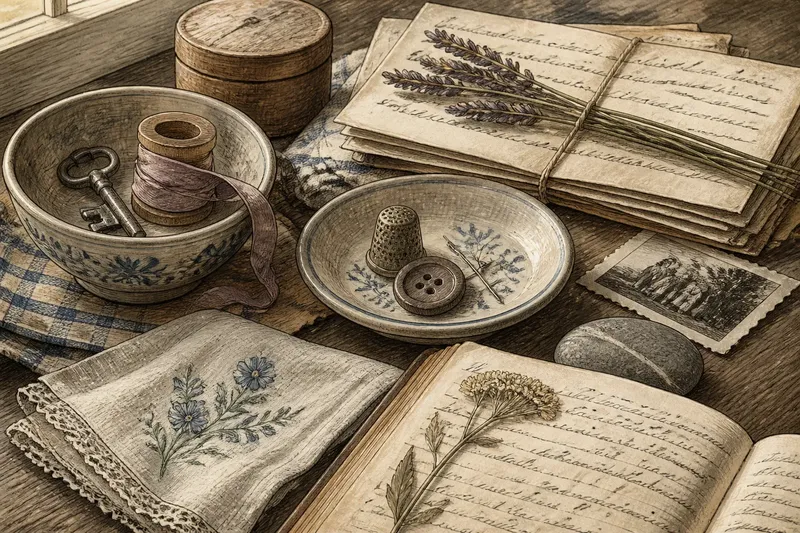
Before mementos became easy to buy as packaged reminders of a place, people held on to objects already folded into ordinary life: a ribbon from a gift, a worn tool, a handwritten note, a pebble picked up on a walk. These things did not need to look distinctive to anyone else. Their value came from the relationship between an object and the person who kept it.
Memory in the Hand
Touch makes a keepsake different from an image saved in a folder. A smooth stone can be turned over; a letter can be unfolded at its creases; a piece of fabric can be recognized by its texture before its story comes back. Handling gives memory a small physical routine. The object is not merely viewed but encountered again.
That routine need not be elaborate. Someone might keep a wooden button from a relative’s coat in a sewing tin, where it shifts among needles and spare thread. Finding it during an ordinary repair can recall the person more sharply than a formal display would. The button’s usefulness and humble scale are part of its character: it remains within reach of everyday life.
Wear can contribute to meaning, but damage is not a requirement. A polished edge, soft fold, or fading mark may record repeated contact. By contrast, an object stored untouched can still matter because it holds a story or came from a particular person. The question is not whether it looks old, but what kind of relationship its present condition makes possible.
This is why keepsakes are often modest. A chipped cup used by a grandparent may bring back their kitchen more vividly than an expensive object chosen to represent it. Like a key kept in a drawer after the lock is gone, the object can outlast its original task while still carrying a trace of the life around it.
Gifted Meaning
A gift arrives with a relationship attached. The giver may choose an object because it suits the recipient, because it recalls a shared moment, or simply because it was available and offered with care. Once accepted, the recipient can give it meanings the giver never intended. A scarf becomes a keepsake not because it was made as one, but because it was worn on a memorable visit or handed over at a difficult moment.
Gifting can also transfer the right to remember. A note tucked into a book, a recipe written in a familiar hand, or a small household object passed between relatives carries more than its material. It conveys an account of who chose it, who used it, and who decided it should continue with someone else. The story may change as it is retold, but the object gives that story a place to gather.
Not every gift becomes precious, and recipients do not owe an object permanent display. Some gifts are useful for a season; others become difficult to keep. It is reasonable to preserve the memory without preserving every item. A photograph, a written recollection, or a conversation with the giver may hold what matters when the physical object no longer fits the recipient’s life.
Display or Use?
One approach is to keep a keepsake in active use. A serving spoon inherited from a relative might stay in the kitchen, carrying its story into meals rather than being placed behind glass. This suits people who enjoy everyday contact and do not mind ordinary wear. It is less suitable when an object is fragile, unsafe to use, or emotionally easier to approach at a distance.
A second approach is to display the object. A postcard on a desk, a small framed piece of fabric, or a shell on a windowsill can make a memory visible without requiring a special occasion. Display suits people who like a quiet reminder in their daily surroundings. It asks for a little thought about placement: an object in a crowded corner may disappear from attention, while a carefully chosen spot lets it be noticed without turning the room into a museum.
A third approach is to store the keepsake and bring it out when wanted. A bundle of letters in an archival folder or a small collection in a labeled box offers privacy and protection. This suits objects that are delicate, intimate, or meaningful in a way the owner prefers not to explain to visitors. The trade-off is that a stored object can be forgotten, so a clear, ordinary label—“letters from Aunt May,” for example—can make it easier to find without prescribing what the owner should feel.
Choosing among use, display, and storage need not be permanent. A keepsake can move between them as a household changes. The useful question is which relationship feels right now: frequent contact, a visible reminder, or the freedom to return to the object privately.
Choosing a Home
Imagine you inherit a small brass thimble from a relative who sewed clothes for the family. You remember her hands at the table, but the thimble is too small for your own use and you do not want it among loose change. You place it in a shallow dish beside your sewing basket, where its familiar shape is visible and it stays close to the activity it recalls. If it begins to feel like clutter, you can move it to a labeled box without losing the story; the choice is about access, not the strength of your affection.
A few practical questions can help decide where a keepsake belongs:
- What memory does it hold? Name the person, occasion, or shared routine that gives the object meaning.
- Does handling matter? If touch is central, choose a safe, convenient place rather than a display that puts the object out of reach.
- Can it tolerate use or light? Fragile paper, textiles, and photographs may need protection from sunlight, moisture, and frequent contact.
- Who else shares its story? A family object may call for a conversation about ownership or passing it along.
- Would a record be enough? If the physical item no longer suits your home, a photograph and a written account may preserve its context.
For care, keep the object clean and dry in a way suited to its material, and avoid applying polish, adhesive, or cleaning products simply to make it look newer. For fragile or valuable items, follow the maker’s or conservator’s guidance; the right approach depends on the material and its condition.
Souvenir or Keepsake?
The difference is not always visible. A shop-bought object can become deeply personal after it is given, used, or connected to a particular memory. A keepsake can also be acquired during travel. The distinction lies less in where an object came from than in how its meaning developed. A souvenir often begins as a ready-made sign of a place; a keepsake gathers significance through a specific relationship or remembered moment.
That difference helps explain why two people can react differently to similar objects. A printed magnet may be a casual reminder for one person and the only surviving trace of a family trip for another. Neither response is more correct. The object’s meaning belongs to the life in which it is kept, not to its price, rarity, or intended category.
Questions About Keepsakes?
Can an ordinary object become a keepsake?
Yes. A household item can gather meaning through repeated use, a gift, or an association with someone important. Its plain appearance does not make the memory less real.
Do keepsakes need to be old?
No. An object can matter as soon as it becomes tied to a person or moment. Age may add visible wear, but time alone does not create personal significance.
What if I cannot keep a family object?
Tell the other people connected to it, if appropriate, and consider whether someone else would value it. A photograph and a short account of its history can also retain context when the object must leave your home.
How should I choose a keepsake to give?
Choose something that fits the recipient’s habits and the relationship rather than relying on a generic symbol. A useful object, a handwritten note, or something linked to a shared memory can leave room for the recipient to decide how to keep it.
A personal keepsake is not a smaller, more sentimental version of a souvenir. It is an object whose meaning has become specific: to a hand that held it, a person who gave it, or a place in the home where its story can be revisited. If you are deciding what to keep, start with the way you want to encounter the memory. That choice—not the object’s label—can tell you whether it belongs in use, on display, or safely out of sight.